
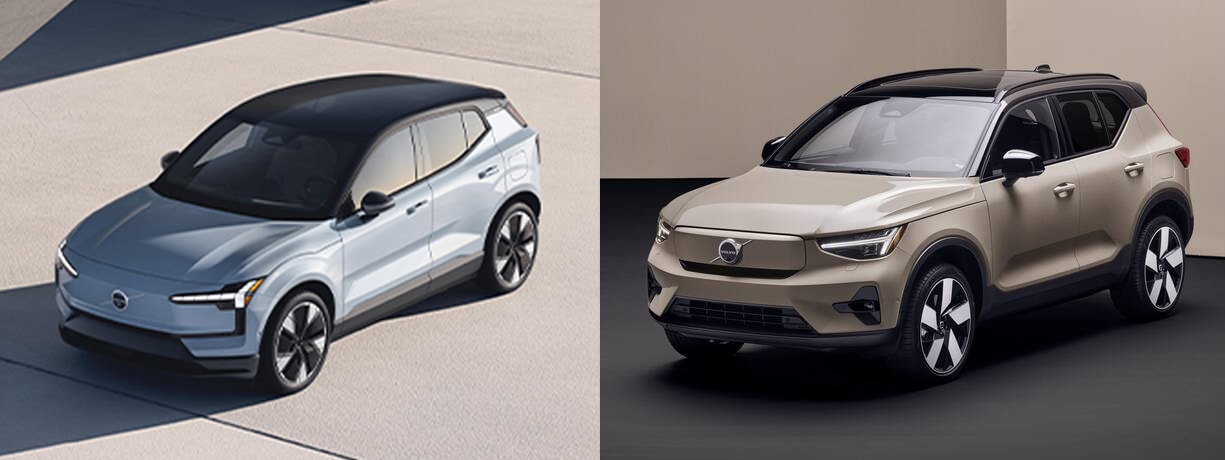
Choosing an electric SUV is no longer simply about deciding whether you are ready to leave gasoline behind. Today's EV shoppers are comparing range, cargo space, performance, charging, technology, safety, and how easily a vehicle fits into everyday life.
For Southern California drivers, those considerations can make the Volvo EX30 and Volvo EX40 particularly interesting. Both are fully electric, five-passenger Volvo SUVs, but they approach electric driving from two different perspectives. The EX30 is Volvo's smallest SUV, with compact dimensions designed for agility and urban convenience. The EX40 provides more interior and cargo space while maintaining a relatively compact footprint.
For drivers in Ontario, Rancho Cucamonga, Upland, Eastvale, Chino Hills, Riverside, and surrounding Inland Empire communities, either could be an appealing introduction to electric Volvo ownership.
This EX30 vs. EX40 comparison looks at electric range, cargo space, performance, safety features, charging, and everyday practicality to help California shoppers decide which makes most sense for you and your family.
EX30 vs. EX40 Comparison: Understanding the Biggest Difference
For drivers around Ontario, Rancho Cucamonga, Upland, and Riverside, the choice ultimately comes down to how much space you need. The smaller EX30 can be easier to maneuver through crowded parking lots, garages, and urban streets, while the EX40 provides noticeably more room for passengers and cargo without moving into a large SUV.
EX30 vs. EX40 Size at a Glance
| Dimension | Volvo EX30 | Volvo EX40 |
|---|---|---|
| Length | 166.7 in. | 174.8 in. |
| Height | 61.0 in. | 65.0 in. |
| Width | 72.4 in. | 75.2 in. |
| Wheelbase | 104.3 in. | 106.4 in. |
| Rear Legroom | 32.3 in. | 36.1 in. |
| Rear Shoulder Room | 53.0 in. | 56.3 in. |
| Maximum Cargo Capacity | 27.8 cu. ft. | 57.5 cu. ft. |
Who Should Consider the EX30?
The EX30 can be an excellent match for singles and couples, first-time EV buyers, drivers with shorter daily commutes, households looking for a second vehicle, drivers frequently using parking garages or tight parking spaces and buyers who want impressive electric performance in a small package.
Its compact dimensions can be especially useful for commuting around Ontario, parking in Downtown Riverside, or navigating crowded shopping areas throughout Rancho Cucamonga.
Who Should Consider the EX40?
The EX40 may make more sense for small families, drivers who regularly carry more cargo, buyers who want greater maximum electric range, weekend travelers, drivers who prefer a more traditional compact SUV footprint and EV owners who want up to 2,000 pounds of towing capacity.
The EX40 offers more room without moving into the dimensions of a large SUV. Volvo lists seating for five and a maximum towing capacity of 2,000 pounds for current configurations.
Volvo EX30 Electric Range: Compact Size with Everyday Capability
Range is understandably one of the first specifications shoppers consider when moving to an EV.
For 2026, the Volvo EX30 Single Motor Extended Range offers an estimated range of up to 261 miles. The Twin Motor Performance configuration offers up to 253 miles, while the EX30 Cross Country is rated at up to 227 miles. Volvo notes that actual range varies based on factors such as driving conditions, driving behavior, vehicle maintenance, battery condition, and other variables.
Volvo EX40 Electric Range: More Range for Longer Drives
If maximum range is a priority, the EX40 has a clear advantage.
The 2026 EX40 Single Motor Extended Range offers an EPA-estimated range of up to 296 miles. The Twin Motor version offers up to 260 miles.
That means the EX40 Single Motor Extended Range offers 35 miles more estimated maximum range than the EX30 Single Motor Extended Range.
When the EX40's Extra Range Matters
That additional range may be particularly valuable for drivers who:
- Have longer daily commutes
- Frequently travel throughout Southern California
- Make regular trips into Los Angeles or Orange County
- Want additional flexibility between charging stops
- Take frequent weekend trips
If your weekends regularly include travel through the Inland Empire and greater Southern California, the EX40's additional estimated range may provide extra flexibility.
Range should not be the only reason to choose between these SUVs, but for high-mileage drivers, it can be an important deciding factor.
Charging the Volvo EX30 vs. EX40
Both vehicles are designed to make public fast charging practical.
Volvo lists a 10-to-80-percent DC fast-charge time of approximately 28 minutes for the EX40 when using suitable charging equipment. The EX30 can complete a comparable 10-to-80-percent charge in approximately 26.5 minutes under Volvo's stated conditions. Actual charging times vary with factors including outdoor temperature, battery temperature, charging equipment, battery condition, and vehicle condition.
Both vehicles can also use Google Maps to help locate charging stations.
For drivers who can install Level 2 charging at home, much of the day-to-day EV experience can happen without making dedicated charging stops at all.
Volvo EX30 vs. EX40 Cargo Space
This is where the difference in vehicle size becomes much more noticeable.
Volvo EX30 Cargo Space
The EX30 provides:
- 11.2 cubic feet behind the second row under Volvo's standard cargo measurement
- Up to 12.4 cubic feet maximum with the second row upright
- Up to 27.8 cubic feet maximum with the rear seats folded
Despite its compact dimensions, the EX30 can still handle groceries, everyday bags, smaller luggage, and many of the items drivers carry during a normal week.
For a couple or individual who prioritizes maneuverability over maximum storage, that tradeoff can make sense.
Volvo EX40 Cargo Space
The EX40 substantially increases cargo capacity.
Volvo lists:
- 14.5 cubic feet behind the second row under its standard measurement
- Up to 18.9 cubic feet maximum with the second row upright
- Up to 57.5 cubic feet maximum with the seats folded
Volvo also designed the rear cargo area with the inner wheel arches positioned to create a wider, flatter floor.
For families carrying strollers, sports equipment, luggage, camping gear, or larger shopping loads, the EX40 is clearly the more versatile option.
Volvo EX30 vs. EX40 Performance
Electric vehicles can deliver immediate acceleration, but the EX30 and EX40 demonstrate that EV performance does not have to mean the same thing for every driver.
EX30 Performance
The EX30 Single Motor Extended Range produces up to 268 horsepower and can accelerate from 0 to 60 mph in 5.1 seconds according to Volvo.
Move to the Twin Motor Performance version and output rises to 422 horsepower, with Volvo listing a 0-to-60-mph time of 3.4 seconds.
For such a small SUV, that makes the dual-motor EX30 remarkably quick.
The EX30's compact dimensions also contribute to its character. Around city streets, freeway entrances, and winding Southern California roads, its smaller footprint can feel agile and responsive.
EX40 Performance
The EX40 Single Motor Extended Range produces up to 248 horsepower and reaches 60 mph in 6.9 seconds. The Twin Motor version produces up to 402 horsepower and reaches 60 mph in as little as 4.6 seconds according to Volvo's current specifications.
The EX40 may not match the EX30 Twin Motor Performance's acceleration, but it combines substantial power with more passenger and cargo capacity.
Volvo EX30 vs. EX40 Safety Features
Safety remains central to both vehicles as the EX30 and EX40 share an extensive list of safety features.
They both have a Driver Alert system that uses an infrared sensor to monitor eye and head movements alongside other vehicle data to identify signs of distraction or drowsiness.
Available Pilot Assist can support speed management, following distance, steering, and certain lane changes while the driver remains attentive and in control.
Its collision avoidance system can help detect vehicles, pedestrians, cyclists, and large animals, warn the driver, and automatically brake if the driver does not respond.
Additional technologies include:
- Blind Spot Information System (BLIS)
- Lane Keeping Aid
- Steering support for certain lane-departure situations
- Cross Traffic Alert with auto brake
- Available 360-degree parking view
Both vehicles provide meaningful driver assistance, although no system replaces attentive, responsible driving.
Final Thoughts: Compare the Volvo EX30 and EX40 at Volvo Cars Ontario
The Volvo EX30 vs. EX40 comparison is less about finding a single "better" electric SUV and more about determining what kind of EV ownership experience fits your lifestyle.
The EX30 embraces compact electric driving. It is agile, surprisingly quick, technology-focused, and well suited to commuters and drivers who spend much of their time navigating Southern California's busier communities.
The EX40 provides a different kind of flexibility. Its maximum EPA-estimated range reaches up to 296 miles in Single Motor Extended Range form, and its 57.5 cubic feet of maximum cargo capacity makes it better suited to families, road trips, and drivers who regularly need additional storage.
For drivers around Ontario, Rancho Cucamonga, Upland, Chino Hills, Eastvale, and Riverside, the best way to choose is to experience both vehicles side by side. Sit in the rear seats, load the cargo area, explore the technology, and consider how each vehicle would fit into your normal week.
Visit Volvo Cars Ontario to compare the EX30 and EX40 and discover which fully electric Volvo offers the right combination of range, space, performance, safety, and everyday practicality for your California lifestyle.